
 tools
tools What if states could see teacher shortages before they happen?
Teacher shortages—especially in high-need STEM subjects—have faced a familiar challenge: not enough qualified teachers, and not enough insight into why shortages persist or where they’ll emerge next.
Beyond100K’s national mapping of the STEM teacher ecosystem shows just how complex this challenge is. Teacher shortages are driven by interconnected factors: preparation pathways, licensure hurdles, workplace conditions, compensation, geography, and more. Yet one lever consistently stands out for its power to drive smarter, faster solutions: clear, usable data on teacher supply and demand.
Most states already collect critical information across educator preparation, licensure, hiring, and retention. Yet that data often lives in disconnected systems, making it difficult for leaders to forecast needs, target supports, or evaluate what’s working. To address this gap, Beyond100K launched the Solution Lab to Accelerate Teacher Workforce Data Systems, a national effort to help states strengthen how they understand and plan for their educator workforce.
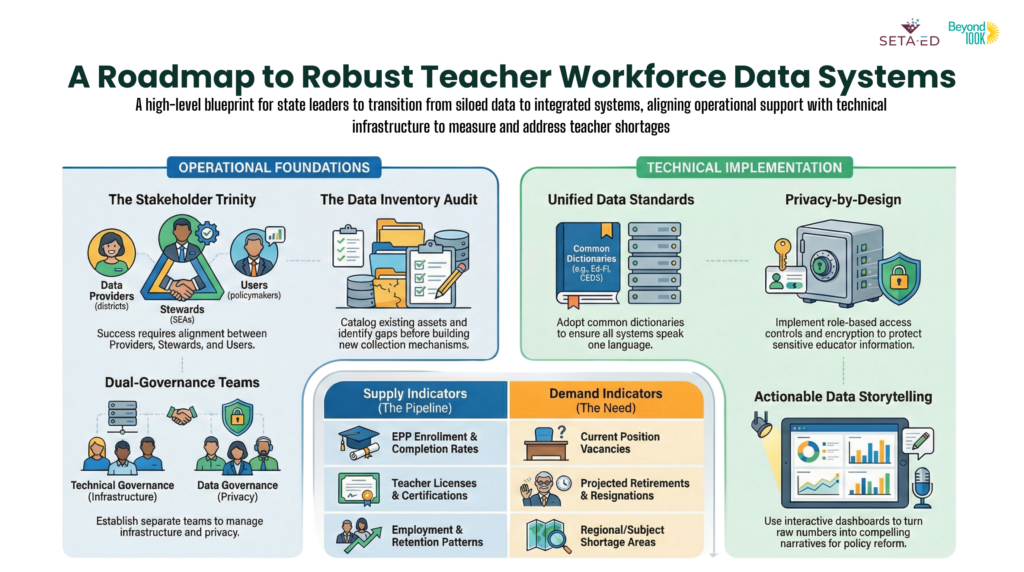
To support leaders in stitching these pieces together, Beyond100K and SETA-ED developed the Roadmap for Developing a Robust Teacher Workforce Data System—a practical, 10-step framework designed to help states:
- Identify current trends in teacher supply and demand
- Forecast future workforce needs before shortages emerge
- Use data to drive policy, investment, and program decisions
Data systems can seem really complex so we’ve broken it down into 10 key components:
1. Stakeholder Buy-In
This foundational component focuses on identifying and securing commitment from each of the key players in the teacher workforce ecosystems, including data providers, data stewards, and data users. Success hinges on establishing strong buy-in and governance frameworks to ensure systems function effectively and are embraced by the communities they are designed to serve.
2. Data Discovery
This component is a comprehensive audit of existing data assets so states can understand what data they already have and identify critical gaps in their information landscape. Having a foundational understanding of existing data, gaps, and barriers enables states to make informed decisions about what new data efforts they should focus on.
3. Building a Team
A successful teacher workforce data system requires more than technology and data – it demands a skilled team responsible for designing, implementing, governing, and maintaining the data infrastructure. This component focuses on assembling a technical team responsible for infrastructure and a data governance team responsible for stakeholder relationships.
4. Standardizing Data
One of the most critical yet challenging aspects of building a comprehensive teacher workforce data system is establishing standardized definitions, formats, and coding schemes. This component addresses these challenges by offering resources and tips for building a data dictionary and defining key terms.
5. Data Infrastructure Implementation
This component is the most intensive phase of system development, requiring careful architectural decisions, robust security implementations, and skilled technical execution. This phase of the Roadmap provides resources and examples on how to design and build the architecture using a data standard and specify data security and privacy requirements.
6. Data Collection Mechanisms and Intervals
Effective and useful teacher workforce data systems require well-designed and simple interfaces for streamlining frequent data collection from various data providers. Developing clear and easy data collection protocols, intervals, and formats can ensure consistent data quality and reduce stress and burden on data providers.
7. Clean, Quality Check, and Merge Data
To effectively track teacher supply and demand over time and understand how factors along the pipeline influence these dynamics, states need integrated data sources. Two crucial steps to achieving this are ensuring different sources of educator data can talk to one another and joining data across sources to better see longitudinal and intersectional trends.
8. Data Visualization and Reporting
In order for a wide array of data users to be able to understand, access, and leverage data, it needs to be easily accessible and relatively simple to find and pull the data they are interested in. This component provides ideas around how data can be shared and made accessible without compromising security, including examples like dynamic dashboards, data visualizations, and even AI-powered data exploration.
9. Supporting Data-Driving Initiatives
States with robust workforce data systems can move beyond reactive emergency politics to proactive, evidence-based solutions. To do this, states should combine their data systems with impactful analytics and communications through data storytelling: the practice of combining analytics with narrative techniques to transform raw numbers and data into meaningful stories that resonate with audiences and drive action.
10. Sustainability and Expansion
The foundation of a sustainable system is an engaged, knowledgeable user base that sees clear value in the system and actively advocates for its continued development and support. Actively engaging this user base includes tactics like creating feedback loops, providing training, streamlining collection and submission processes, and providing dedicated technical support.
Additional Resources
The Teacher Shortage Mystery Video
The Roadmap to Robust Teacher Workforce Data Systems Infographic
Component Explainer Videos
- Component 1: Stakeholder Buy-In
- Component 2: Data Discovery
- Component 3: Building a Team
- Component 4: Standardizing Data
- Component 5: Data Infrastructure Implementation
- Component 6: Data Collection Mechanisms and Intervals
- Component 7: Clean, Quality Check, and Merge Data
- Component 8: Data Visualization and Reporting
- Component 9: Supporting Data-Driven Initiatives
- Component 10: Sustainability and Expansion
Thank you to our Co-publishers!
Thank you to the state agencies that helped fund, inform, and develop the Roadmap, including The New Mexico Public Education Department and the Arkansas Department of Education. Their generous contribution of funds, time, and staff were integral in the creation of The Roadmap and associated resources.

 tools
tools